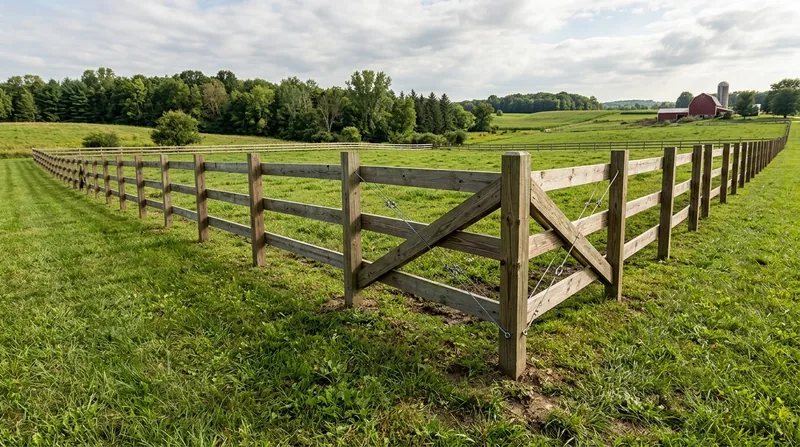




Farm fence installation in Milwaukee and the surrounding counties serves homeowners and rural property owners who need durable perimeter fencing for acreage, livestock operations, and equipment access. North and west of the city, in Washington, Walworth, Dodge, and Jefferson counties, the fence line carries real working load: horses test it, equipment has to pass through safely, and the gate must hold under weather and use. We build ranch rail, no-climb horse fence, field wire, and pipe fencing designed to withstand livestock pressure and the demands of working land. Since 2012, we have installed and repaired farm and ranch fencing across Greater Milwaukee, and we understand the difference between a residential privacy fence and a fence that has to perform under load.
Why Farm and Ranch Fencing Matters on Milwaukee-Area Acreage
A property line on working land is not just a boundary. It defines where your livestock can graze, where equipment moves, and where neighbors' animals stop. The right fence holds animals safely, lasts through seasonal weather changes, and makes daily operation simpler. Poor fencing leads to escaped animals, liability concerns, and costly repairs. A well-built ranch fence protects your investment and your peace of mind.
- We install split rail fence installation for a classic look that suits rural property and allows sight lines across pasture.
- We build no-climb horse fence with smooth mesh and solid construction so horses cannot catch hooves or legs.
- We set pipe fence installation for heavy-duty perimeter work where durability and appearance matter equally.
- We install barbed wire and field wire fencing for livestock containment and cost-effective property definition.
- We design and hang gates sized for equipment passage, with hardware that stands up to daily use and weather.
Each of these approaches solves a different problem on your land, and we size the job to your animals, your terrain, and your equipment.
Key info: Wisconsin 811 utility locates are required by law before we dig post holes. We handle that call so you do not have to. Locating buried electric, gas, water, and fiber lines prevents damage, injury, and costly repairs. Call us, we call 811, the utilities mark the lines, and we fence safely.
For permitting and setback rules on acreage in Washington, Walworth, Dodge, and Jefferson counties, check with your local town or county building department. Rules vary, and deed restrictions or easements on rural property often apply. We work from your existing survey and install on the line you identify.
How We Build Farm and Ranch Fencing Near Me: The Milwaukee Process
Farm fencing starts with a clear picture of your property, your animals, and your access needs. We walk the fence line, check for underground utilities, confirm the boundary with you, and discuss gate placement and size. Then we build to last. Posts are set deep in concrete for stability against livestock pressure and seasonal frost. Rails or mesh are secured tight so animals cannot push through or create gaps. Every joint is solid, and every gate swings true.
- We schedule a site visit to walk the property, identify the fence line, and understand your animals and equipment needs.
- We call 811 to locate underground utilities and mark the safe digging zone along your fence line.
- We set posts deep in concrete at proper spacing, typically 6 to 8 feet for rail and mesh fencing, depending on the method.
- We install rails, mesh, or pipe horizontally and secure them so they do not sag, twist, or give under animal pressure.
- We hang gates with self-closing and self-latching hardware where appropriate, sized to fit equipment and animals.
- We inspect the completed fence, walk it with you, and explain maintenance and care so it holds for years.
This step-by-step approach means no surprises, no rework, and a fence that does the job you bought it to do.
Example: A horse owner in Germantown needed a 200-foot perimeter for a small paddock. We installed no-climb mesh fence on sturdy posts set in concrete, with two gates sized for equipment and feed delivery. The fence is smooth, safe, and has held through multiple seasons of use and weather.
Farm and Ranch Fencing Methods
| Method | Description | Best For |
|---|---|---|
| Split Rail | Wooden rails mortised into posts, typically 2 or 3 rails high, spaced 6 to 8 feet apart. | Pasture boundaries, visual appeal, lighter containment, and rural aesthetic. |
| No-Climb Horse Fence | Welded mesh panels (typically 2 inches by 2 inches) mounted on sturdy posts, smooth and rigid. | Horses and livestock that need safe, escape-proof containment without sharp edges or climbing risk. |
| Pipe Fencing | Steel or galvanized pipe set in concrete, with horizontal pipe rails or cable. Heavy-duty and long-lasting. | High-use areas, equipment access, and perimeter work where strength and durability are priorities. |
| Field Wire and Barbed Wire | Wire mesh or barbed wire strung between posts on wooden or steel frames, cost-effective and functional. | Cattle, pasture boundaries, large acreage, and situations where cost per linear foot is a primary concern. |
Farm and Ranch Fencing Cost in Milwaukee: What to Expect
Farm fence installation pricing depends on the method, the terrain, post spacing, and gate requirements. Split rail fencing and field wire are less expensive per linear foot than no-climb mesh or pipe. Gate size and hardware add to the total. The best way to know your cost is to have us walk your property, measure the fence line, and give you a firm estimate based on what you need.
Starting points vary widely. A simple field wire fence may run $8 to $12 per linear foot installed. No-climb horse fence typically runs $15 to $25 per linear foot depending on mesh quality and post depth. Pipe fencing and heavy-duty ranch rail run higher. Gates add $300 to $1,500 or more depending on size and hardware. See our full pricing page for detailed breakdowns and current rates.
We recommend getting two or three estimates so you can compare method, material quality, warranty, and timeline. A low price is not the only measure of value. A fence built to last 15 to 20 years with proper maintenance is worth the investment. Ask each contractor about post depth, concrete versus tamped installation, hardware grade, and their warranty on workmanship.
What to Look for When Hiring a Farm Fence Contractor Near Me
Finding the right fence contractor for your acreage is about more than price. You need someone who understands livestock, equipment access, and the durability standards that working land demands. A contractor who takes time to walk your property, asks about your animals and your plans, and explains the trade-offs between methods is worth your time. Check that they are fully insured and an AFA Member Installer, like we are. Call references and ask about how long their fences have held and whether they stand behind their work.
Permitting rules for farm fencing vary by county and town in Greater Milwaukee. Some jurisdictions require a permit for any fence; others do not. Check with your local town or county building department before you start. If your property is in a master-planned community or has deed restrictions, those rules take precedence over local code. HOA architectural standards may limit height, material, or color. Confirm all rules before you commit to a design.
Get your estimate in writing, with a detailed scope of work, material specifications, post depth and spacing, gate size and hardware, and a timeline. Do not hire on a handshake or a phone quote. A good contractor will be glad to put it in writing and answer your questions. If you need help understanding your options or want a free, no-obligation estimate, contact us at (414) 255-7847.
Farm & Ranch Fencing in Milwaukee: Pricing Guide
| Service | Price | Details |
|---|---|---|
| Split Rail Fence | Starting at $12/ft | Two or three rails on sturdy posts set in concrete, spaced 6 to 8 feet apart, classic rural aesthetic |
| No-Climb Horse Fence | Starting at $18/ft | Welded mesh panels on posts, safe for horses, smooth edges, livestock-grade construction and durability |
| Pipe Fencing | Starting at $20/ft | Galvanized or steel pipe set in concrete, heavy-duty equipment access, long-term durability and low maintenance |
| Field Wire and Barbed Wire | Starting at $8/ft | Wire mesh or barbed wire strung between posts, cost-effective for large acreage and cattle containment |
| Gates and Hardware | $400 to $1,500+ | Equipment-sized gates with self-closing and self-latching hardware, depends on width, material, and operator |
| Free Estimate | No obligation | Walk the property, measure the line, discuss your animals and access needs, provide written quote within 24 hours |
Indicative pricing, the exact cost depends on square footage, finish, and site access. Free personalized estimate within 24h at (414) 255-7847.


